
When the Server Room at the Office Is No Longer Enough. Most businesses start by keeping servers on-premise — it is familiar, controllable, and appears cost-effective. But as systems grow, so do the problems: power outages, cooling failures, internet disruptions, and IT teams racing to the office in the middle of the night to fix hardware.
That is when organizations start asking: "Should we move to Colocation or go with Public Cloud?"
Both options solve the on-premise server problem — but in fundamentally different ways, at different cost profiles, and for different organizational profiles. Choosing the wrong one can mean higher-than-expected costs, insufficient flexibility, or compliance exposure that surfaces later.
What Is Colocation?
Colocation (or "Colo") is a service in which an organization places its own servers and equipment inside a third-party Data Center facility, while sharing the underlying infrastructure — power, cooling, network connectivity, and physical security — with other tenants.
What colocation provides:
- Rack space / Cabinet — from 1U to full rack or private cage
- Redundant power (UPS + Generator) — no single point of power failure
- Precision cooling — controlled temperature around the clock
- Network connectivity — multi-ISP uplinks, dark fiber, private line options
- Physical security — CCTV, biometric access control, on-site security staff
- Remote Hands — DC staff can perform physical tasks on your behalf
What Is Public Cloud?
Public Cloud is an Infrastructure-as-a-Service model in which a provider (such as AWS, Azure, Google Cloud, or KIRZ Cloud) owns and operates all underlying hardware, and customers rent capacity as needed — paying only for what they use.
Key characteristics:
- Pay-as-you-go: Cost matches actual consumption
- Instant scalability: Add or remove resources within minutes
- No hardware management: The provider handles all infrastructure
- Global reach: Deploy across multiple regions worldwide
- Built-in high availability: Redundancy managed by the provider
Colocation vs Public Cloud — Direct Comparison
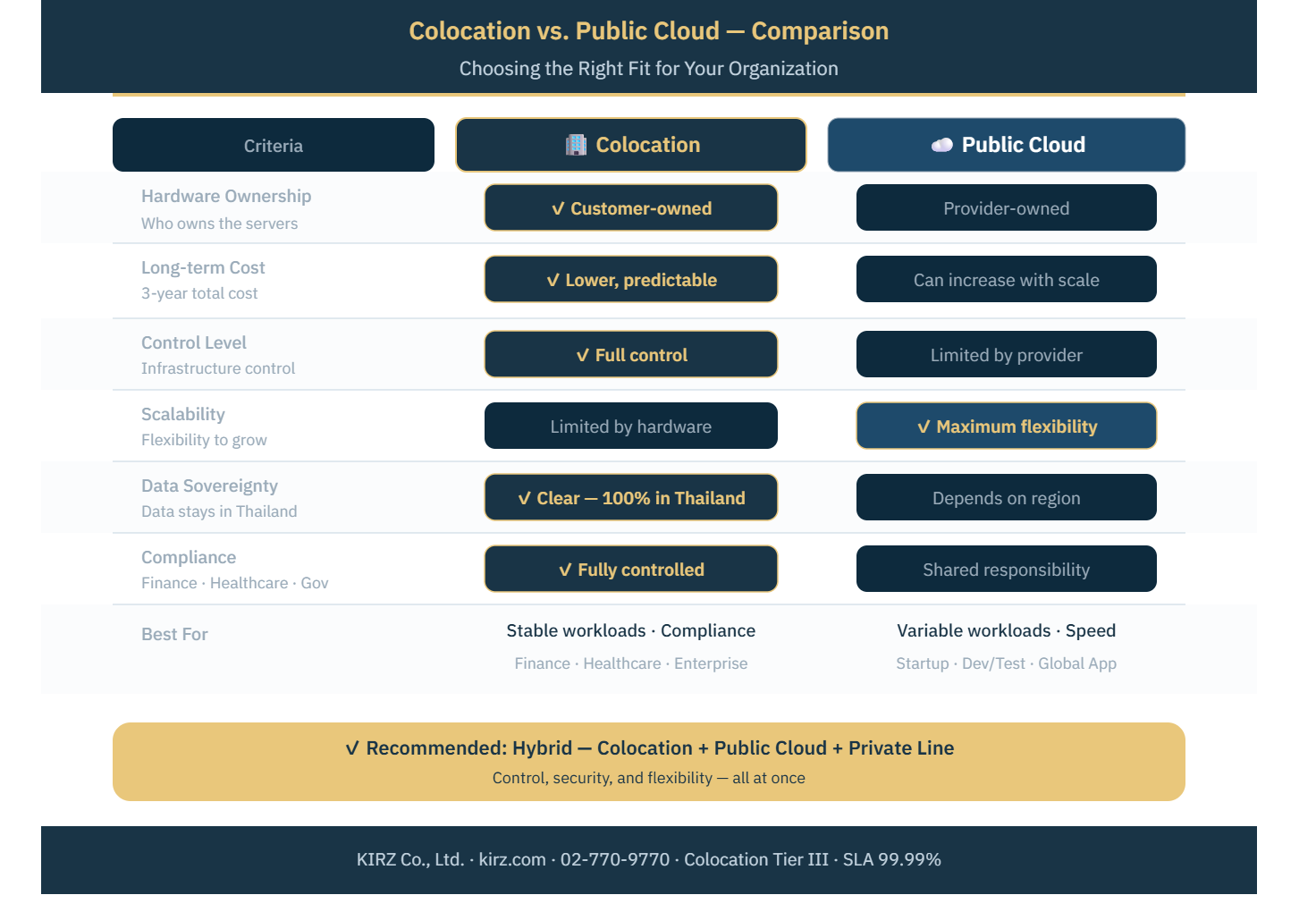
5 Reasons to Choose Colocation
1. You Already Own Hardware
If your organization has servers that are still performant, moving them to a Colo facility delivers the benefits of a professional data center without the cost of replacing working equipment.
2. Workloads That Require Consistent Performance
Large databases, ERP systems, and applications requiring high I/O and predictably low latency perform better on dedicated hardware in a colocation facility than on shared cloud infrastructure.
3. Compliance and Data Sovereignty Requirements
Financial institutions, hospitals, and government-adjacent organizations that must keep data within Thailand and maintain full audit control over their infrastructure find colocation significantly simpler to certify and operate compliantly.
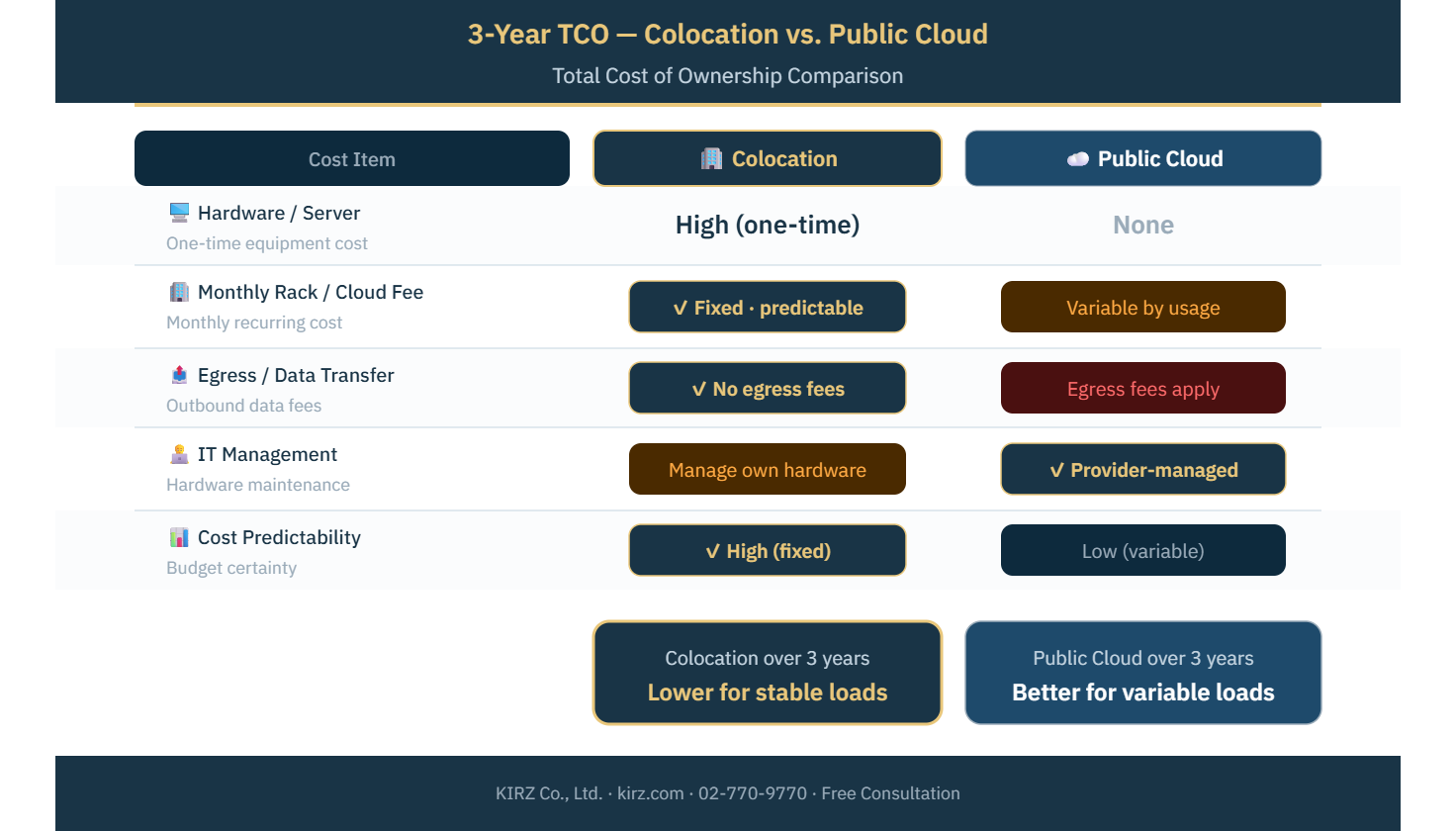
4. Predictable Long-Term Cost Structure
Colocation is priced on a fixed monthly basis — no egress fees, no API call charges, no surprise line items that appear when cloud usage grows. For stable workloads, the 3-year TCO of colocation is typically lower than an equivalent cloud deployment.
5. Flexible Network Connectivity
A colocation facility connected to multiple ISPs allows the customer to choose upstream providers, connect via dark fiber, establish direct private line connections, or build a DCI link to another data center — capabilities that are difficult or impossible to replicate in a pure cloud model.
5 Reasons to Choose Public Cloud
1. Variable or Unpredictable Workloads
E-commerce platforms with traffic spikes during sale periods, startups that do not yet know their true load requirements — public cloud scales up and down instantly without hardware procurement.
2. Speed to Deploy
No hardware purchasing, no rack installation, no physical setup. Cloud instances launch in minutes, making public cloud the right choice for teams that prioritize development speed over infrastructure control.
3. Small IT Team or No Infrastructure Team
Public cloud providers manage hardware failures, OS patches, and facility operations. A small team can focus entirely on application development and business logic rather than infrastructure maintenance.
4. Global Availability Requirements
Deploying across multiple international regions to serve users from different countries is far simpler in public cloud than replicating colocation infrastructure across multiple facilities.
5. Cloud-native Service Requirements
If your architecture depends on managed AI/ML services, serverless computing, or container orchestration platforms, public cloud providers offer mature, integrated ecosystems that colocation facilities cannot replicate.
Hybrid Is the Answer Most Enterprise Organizations Choose
In practice, most mid-to-large organizations operate a Hybrid Cloud Architecture:
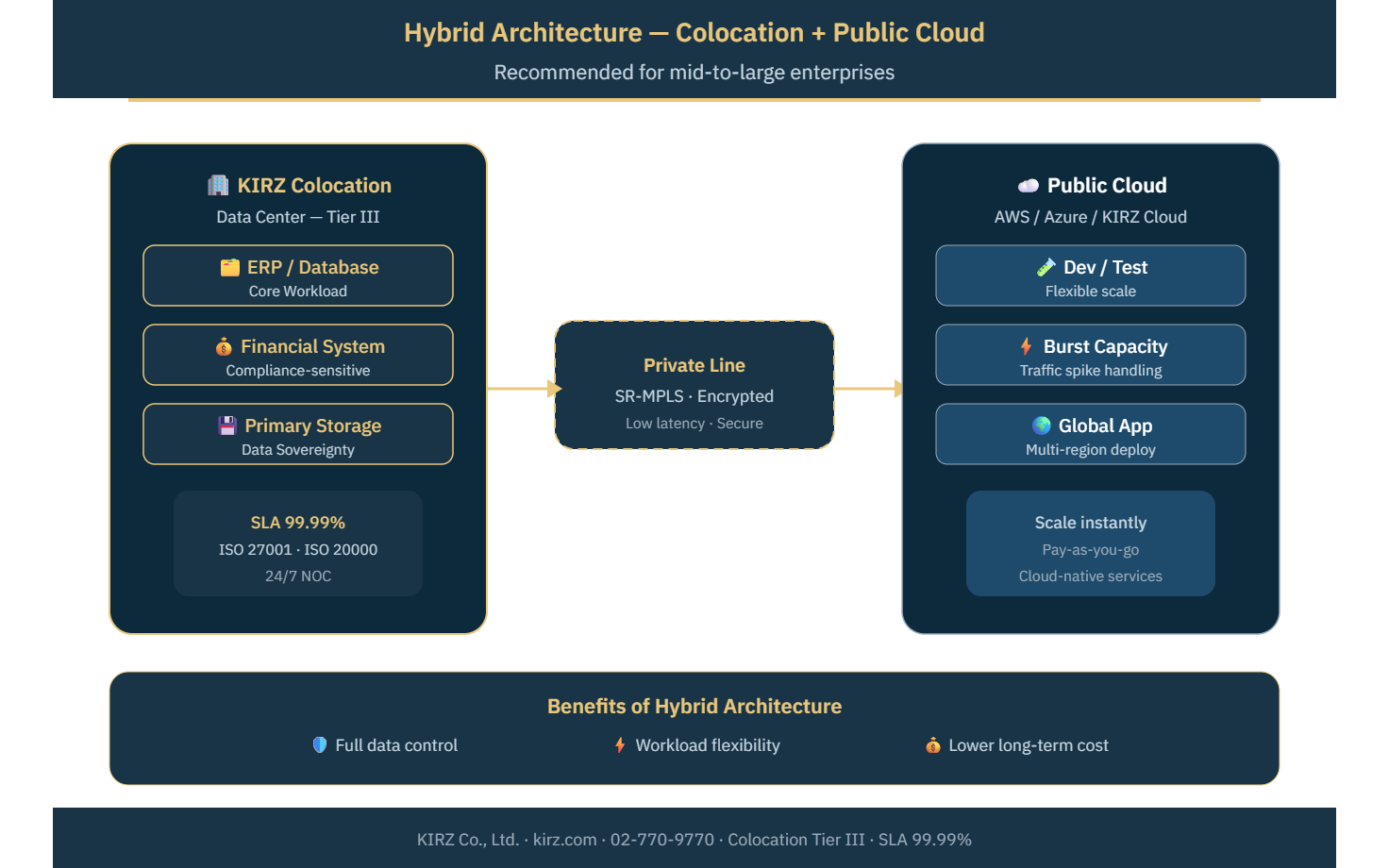
- Colocation — for core workloads, databases, and compliance-sensitive data
- Public Cloud — for development/test environments, burst capacity, and cloud-native applications
- Private Line — connecting the colocation DC to public cloud regions securely and with low latency
This architecture delivers control, security, and flexibility simultaneously — without forcing an all-or-nothing decision between colocation and cloud.
KIRZ Colocation — Enterprise-Grade Data Center in Bangkok
KIRZ operates colocation services in a Tier III standard Data Center with:
| Feature | Detail |
|---|---|
| Space | From 1U to full private cage |
| Power | Redundant UPS + Diesel Generator |
| Cooling | Precision cooling N+1 |
| Network | Multi-ISP · Dark Fiber · Private Line ready |
| Security | 24/7 CCTV · Biometric access · Security staff |
| Connectivity | Direct connection to KIRZ SR-MPLS backbone |
| SLA | 99.99% Uptime |
| Certifications | ISO 27001 · ISO 20000 |
Organizations using KIRZ Colocation can also connect directly to KIRZ Cloud VM and Dark Fiber within the same infrastructure, enabling a seamless hybrid architecture without crossing the public internet.
Conclusion — There Is No Universal Right Answer
Colocation is right for organizations that own hardware, require full data control, and operate stable, predictable workloads.
Public Cloud is right for organizations that need speed, flexibility, and freedom from infrastructure ownership.
Hybrid is the most intelligent choice for organizations that need both — and it is the architecture that most enterprise environments are converging toward.
Interested in comparing the 3-year TCO of Colocation vs. Cloud for your organization?
Contact KIRZ's specialists at kirz.com or call 02-770-9770.