
The Hour Nobody Budgets For
Picture a normal working day. Then the network goes down. Two hundred employees cannot work. The ERP system is unreachable. Purchase orders stop coming in. Customers cannot get through. And the IT team is scrambling.
What does that one hour actually cost your organization?
Most organizations have never calculated this number seriously — until the outage happens. This article gives you the framework to quantify your real downtime exposure and understand why investing in high-availability network infrastructure is not a cost, but a financial decision.
What Is Network Downtime — and What Causes It?
Downtime refers to any period during which network services or systems are unavailable, whether partially or completely.
Common causes:
- Hardware Failure: Router, switch, or fiber cable failure
- ISP / Provider Issues: Problems originating from the network provider's infrastructure
- Human Error: Misconfiguration or untested changes pushed to production
- Cybersecurity Attacks: DDoS or ransomware that disrupts network availability
- Natural Disasters: Flooding, fire, or storms affecting physical infrastructure
Research consistently shows that most organizations experience an average of 14–22 hours of unplanned downtime per year — a figure that sounds modest until you calculate what it actually costs.
How to Calculate Your Downtime Cost
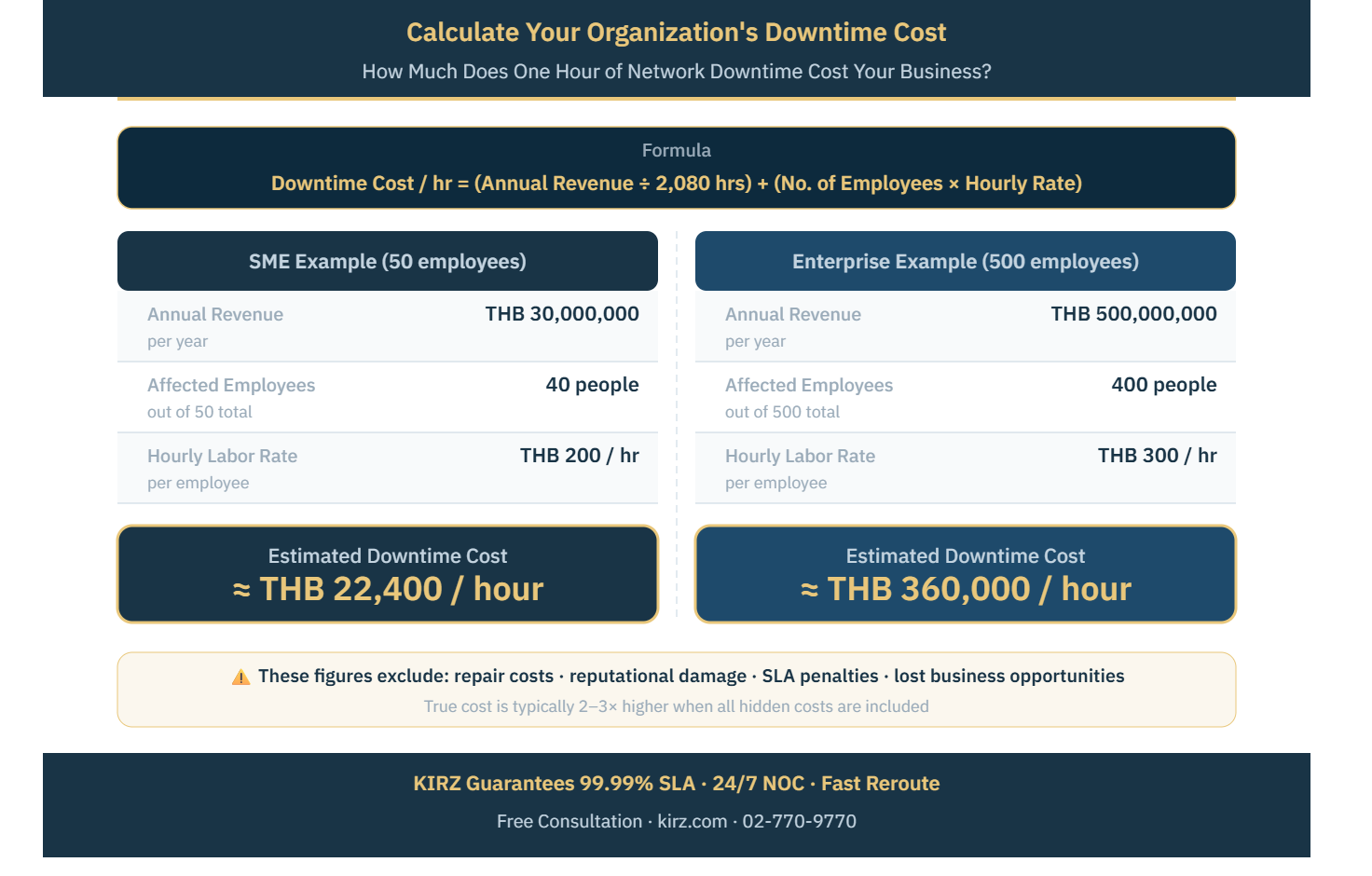
The standard formula used by IT and finance teams:
Downtime Cost (per hour) = (Annual Revenue ÷ Annual Working Hours) + (Affected Employees × Hourly Labor Cost)
Example 1: SME Organization (50 employees)
- Annual revenue: THB 30 million
- Working hours: 2,080 hours/year
- Affected employees: 40 × THB 200/hour
Estimated downtime cost ≈ THB 22,400 per hour
Example 2: Enterprise Organization (500 employees)
- Annual revenue: THB 500 million
- Working hours: 2,080 hours/year
- Affected employees: 400 × THB 300/hour
Estimated downtime cost ≈ THB 360,000 per hour
The Costs You Can See — and the Ones You Cannot
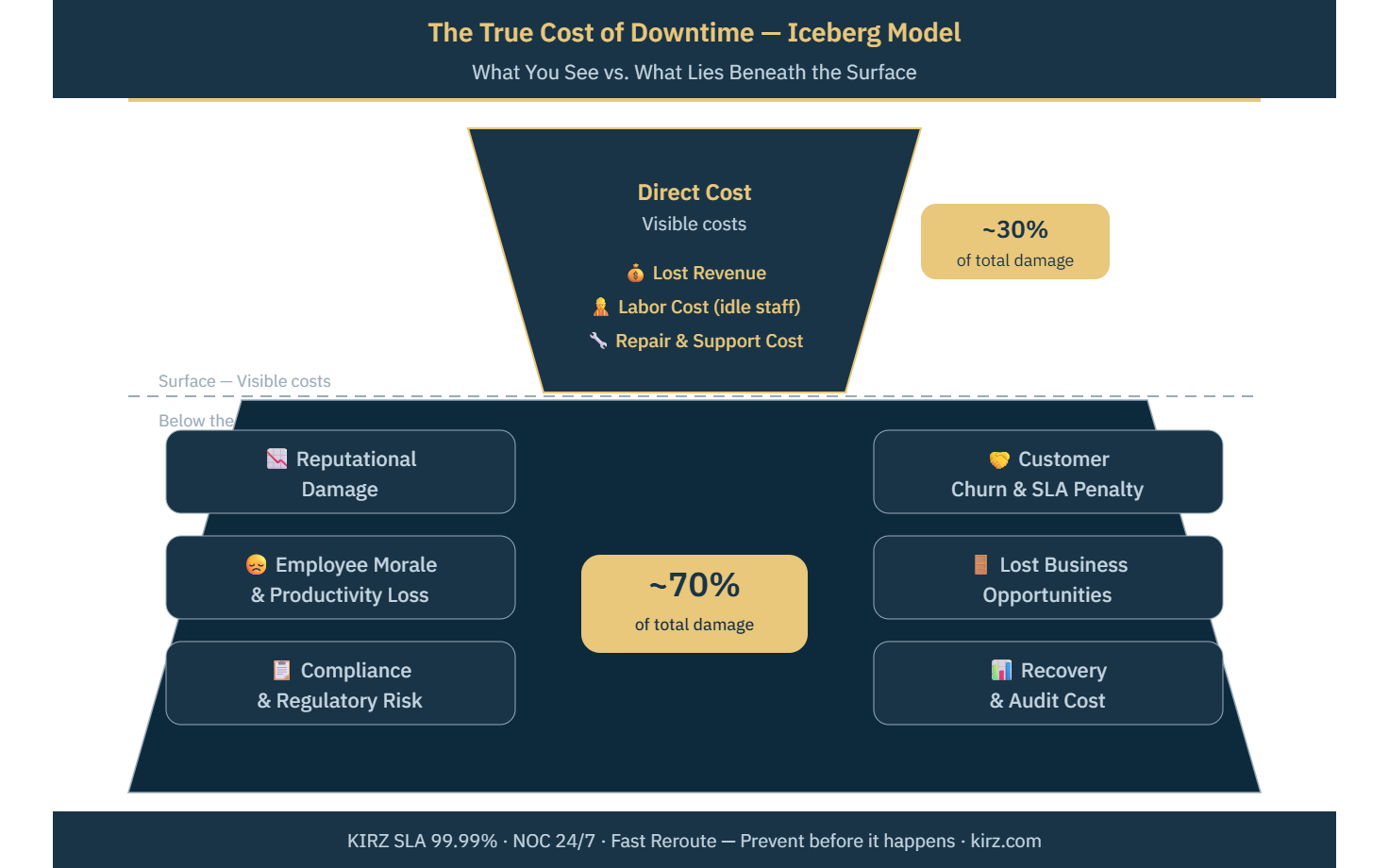
Downtime damage does not end with lost revenue. There are multiple layers of cost, many of which never appear on an incident report.
Direct Costs (Visible)
- Lost revenue: Transactions that could not complete, orders that were not placed
- Labor cost: Salaries paid for hours when employees could not work
- Repair costs: Equipment replacement, IT labor, emergency support fees
Hidden Costs (Invisible)
- Reputational damage: Customers who could not reach you and chose a competitor instead
- Customer dissatisfaction: SLA penalties, increased churn rate, reduced renewal probability
- Employee morale: Stress, frustration, and reduced productivity following a major incident
- Lost business opportunities: Deals that could not close because systems were unavailable
- Compliance exposure: In regulated industries such as finance or healthcare, downtime may trigger regulatory review or fines
99% Uptime Sounds Good — But What Does It Actually Mean?
High SLA percentages are frequently misunderstood. The table below translates them into real downtime hours:
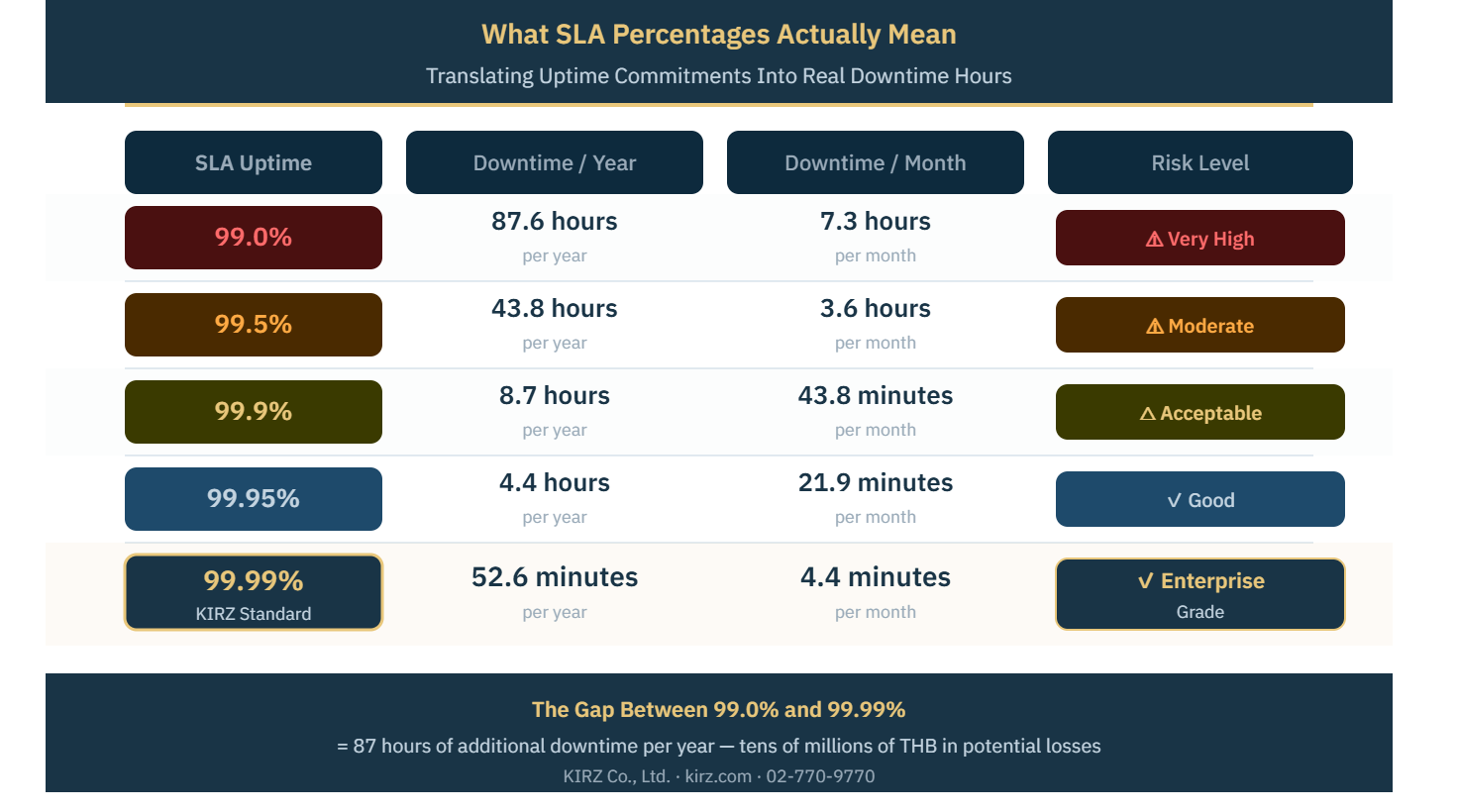
For an enterprise with a downtime cost of THB 360,000 per hour:
- SLA 99.0% = potential annual damage of THB 31.5 million
- SLA 99.99% = maximum annual exposure of THB 315,000
The difference between SLA tiers is not just a number — it is tens of millions of baht in annual risk.
3 Steps to Reduce Downtime Risk
1. Choose a Provider With 99.99% SLA and a Clear Penalty Clause
An SLA is only as valuable as its enforcement. Verify that the contract includes a clear penalty clause defining exactly how the provider will compensate you if the commitment is not met — not just a credit toward future services.
2. Design Redundancy Into the Network From Day One
A resilient network always has a backup path. This means a Primary Private Line paired with a Backup DIA circuit, or an SD-WAN configuration that automatically fails over between paths without human intervention. Redundancy should be built in, not added after the first major outage.
3. Ensure 24/7 NOC Monitoring
The difference between detecting an incident before it affects end users and discovering it only after business has stopped is active, around-the-clock monitoring. A NOC that identifies and responds to anomalies in real time transforms potential outages into managed events.
Conclusion — Investing in Uptime Costs Less Than Recovering From Downtime
When downtime costs are calculated honestly, high-availability network infrastructure with strong SLA guarantees and built-in redundancy almost always represents a better financial outcome than the apparent savings of a cheaper, lower-reliability service.
Organizations that treat the network as an expense tend to absorb the consequences when it fails. Organizations that treat it as a business continuity investment operate with confidence — because when the unexpected happens, their network keeps running.