
As organizations grow, so does the complexity of their network requirements. IT teams regularly face a question that sounds simple but is surprisingly difficult to answer: "Should we go with a Private Line or DIA?"
Both services deliver connectivity — but they are built for fundamentally different use cases. Choosing the wrong one can mean overpaying for features you do not need, or worse, underinvesting in the reliability your operations actually require.
This article breaks down exactly how each service works, which organizations benefit most from each, and how to make the right decision for your infrastructure roadmap.
What Is a Private Line?
A Private Line — also known as a Leased Line — is a point-to-point dedicated circuit that connects two locations directly, without traversing the public internet.
Key characteristics:
- Dedicated Path: The circuit is reserved exclusively for your organization
- Symmetric Bandwidth: Equal upload and download speeds (e.g. 100 Mbps / 100 Mbps)
- Guaranteed SLA: Latency, jitter, and uptime are contractually committed
- Layer 2 or Layer 3: Selectable based on your architecture requirements
KIRZ delivers Private Line over its SR-MPLS (Segment Routing MPLS) backbone, supporting Traffic Engineering and Fast Reroute for maximum resilience and flexibility.
What Is DIA (Dedicated Internet Access)?
DIA stands for Dedicated Internet Access — an internet connection where bandwidth is reserved exclusively for your organization with no sharing with other users.
Key differences from standard broadband:
- No shared bandwidth with other customers
- Symmetric speeds: Full upload and download as contracted
- SLA-backed: Uptime and response times are formally guaranteed
- Static IP included: Fixed IP addresses ready for server hosting from day one
Private Line vs DIA — Side-by-Side Comparison
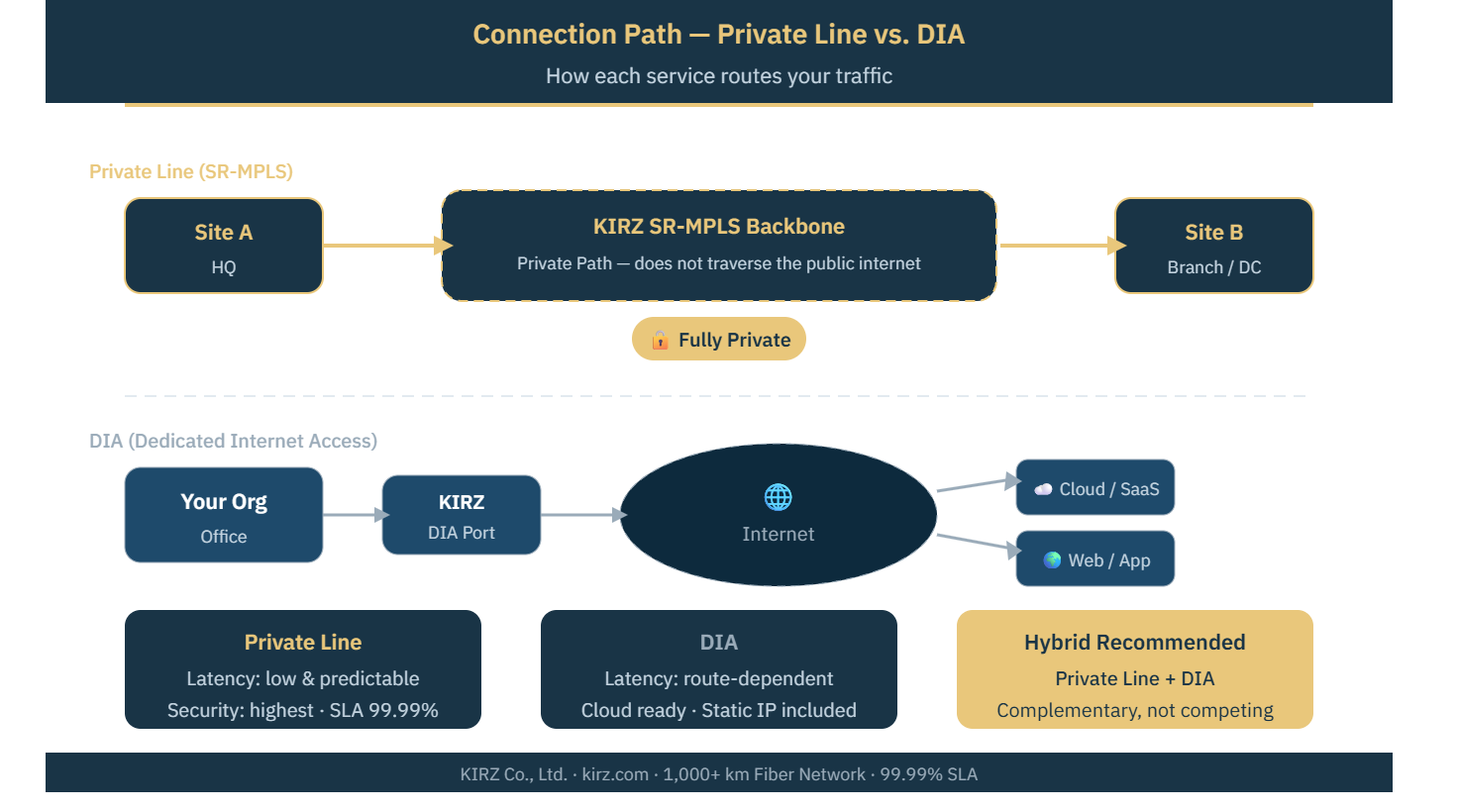
| Private Line (SR-MPLS) | DIA | |
|---|---|---|
| Path | Point-to-point (between two sites) | Customer → Internet |
| Traverses public internet | No | Yes |
| Bandwidth | Symmetric, dedicated | Symmetric, dedicated |
| Latency | Very low, predictable | Depends on internet routing |
| Security | Highest (private path) | Requires Firewall / VPN |
| Static IP | Depends on configuration | Included as standard |
| Best for | Branch links, ERP, Voice, DC | Cloud access, Remote Work, Web |
| Relative cost | Higher | Lower |
4 Scenarios Where Private Line Is the Right Choice
1. Multi-Branch Connectivity Organizations with multiple offices that need stable access to ERP systems, file servers, or VoIP across all sites. Private Line delivers consistent latency and jitter control that internet-based alternatives cannot match.
2. Latency-Sensitive Applications Real-time workloads — video conferencing, VoIP, trading platforms — where even small fluctuations in latency affect quality. Private Line delivers a stable, predictable signal that internet routing simply cannot guarantee.
3. Data Center Connectivity Organizations that colocate servers at a DC and need reliable access from their HQ or branch offices. Private Line provides both the stability and security that internet-based connectivity lacks for this use case.
4. Compliance and Data Privacy Requirements Financial institutions, hospitals, and organizations under strict regulatory frameworks need to ensure that data never travels over public infrastructure. Private Line provides a fully private path with no exposure to the public internet.
4 Scenarios Where DIA Is the Right Choice
1. Access to Multiple Cloud Services Organizations running Microsoft 365, Google Workspace, Salesforce, or multiple SaaS platforms simultaneously. DIA provides efficient, direct access to any cloud destination without requiring separate private links to each provider.
2. Remote Work and Hybrid Workforce Employees working from home or in the field need internet access to reach corporate systems. DIA at HQ or branch sites provides a stable, SLA-backed exit point to the internet for the entire workforce.
3. Hosting Public-Facing Applications Organizations running web servers, mail servers, or externally accessible applications need a fixed IP and dedicated bandwidth. DIA delivers both, with guaranteed performance for inbound and outbound traffic.
4. Cost-Effective Step Up from Broadband For SMEs that require SLA-backed reliability and dedicated bandwidth without the cost of a full Private Line deployment, DIA is the right starting point — delivering a significant reliability upgrade over shared broadband at a manageable investment level.
Can You Use Both Together?
Yes — and most organizations with complex requirements do exactly that.

Recommended architecture:
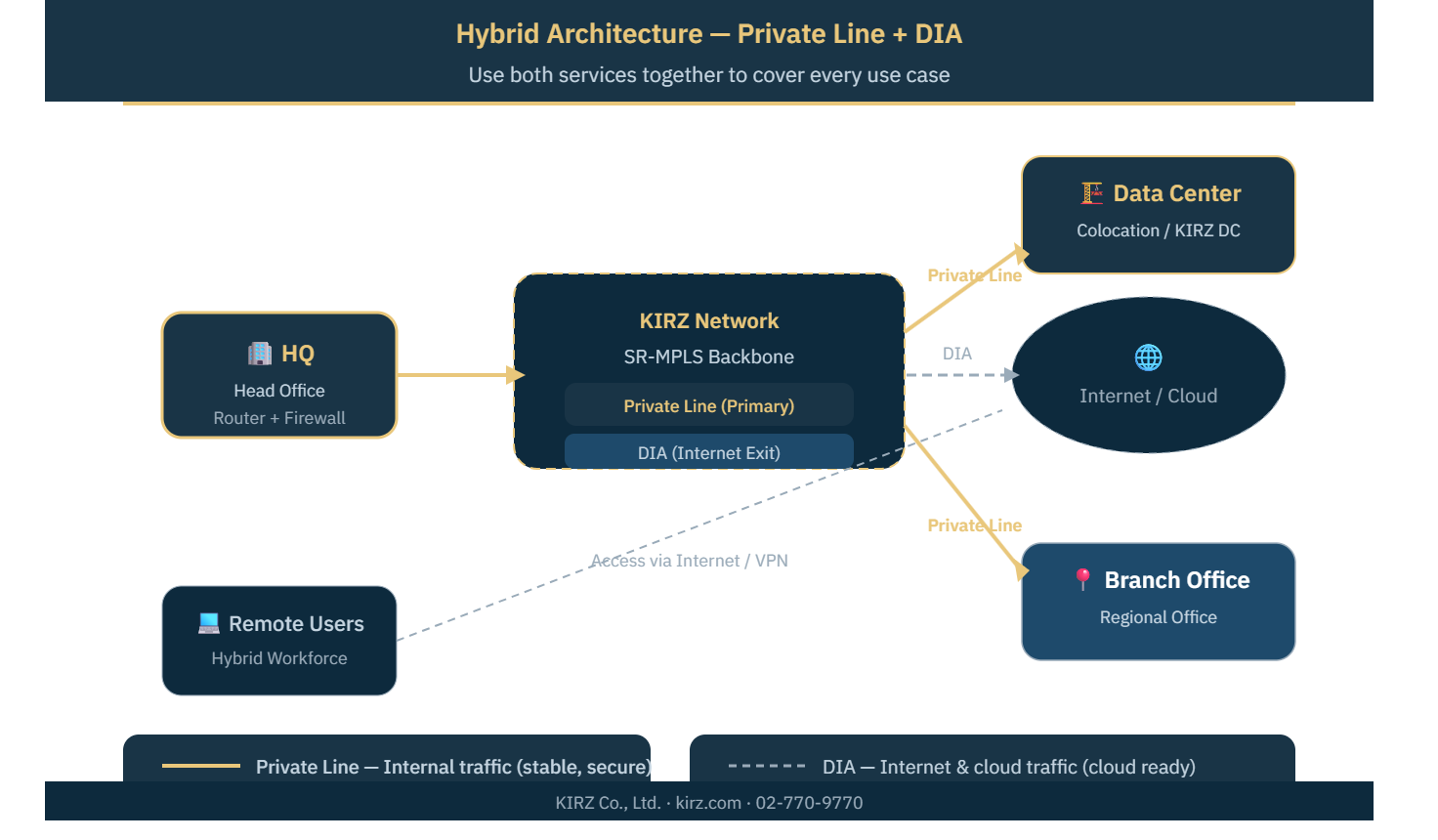
- Private Line → Connects HQ ↔ Data Center ↔ Primary branches (internal traffic)
- DIA → Internet access, cloud connectivity, remote user support
- DIA as backup → If the Private Line experiences an issue, the DIA circuit maintains operations
A well-designed network uses both services in a complementary role — not as competing alternatives. The Private Line handles traffic that demands predictability and privacy; DIA handles everything that needs to reach the broader internet.
KIRZ Delivers Both — On One Backbone
KIRZ offers both Private Line (SR-MPLS) and DIA on its own fiber optic network spanning over 1,000 kilometers across Bangkok and surrounding provinces, backed by a 99.99% SLA and 24/7 NOC monitoring.
KIRZ's Presale team is available to design a network solution matched to your actual use case — whether that means Private Line, DIA, or a hybrid of both.
Conclusion: Choose What Fits, Not Just What Costs Less
Private Line is the right choice when your priority is stable, secure, low-latency connectivity between fixed locations — particularly for internal systems, data centers, and compliance-sensitive workloads.
DIA is the right choice when your priority is reliable, dedicated internet access for cloud services, remote users, and public-facing applications.
The two services are not competitors. They are complementary layers of a well-architected enterprise network. Choosing correctly from the start means fewer performance issues, fewer surprises, and a network that scales with your business.
Ready to design the right network architecture for your organization?
Contact KIRZ's specialists at kirz.com or call 02-770-9770.