
Modern WAN Is More Than Just "Lay a Cable and Done
As organizations expand across multiple sites, the WAN becomes the backbone connecting everything — from ERP and VoIP to cloud applications and video conferencing. IT teams consistently face a pivotal decision: SR-MPLS or SD-WAN?
The two terms sound similar and are often placed in opposition, but they operate at fundamentally different layers of the network. Understanding that difference is the key to making the right architectural decision — and to knowing when deploying both together is the smartest answer.
What Is SR-MPLS?
SR-MPLS (Segment Routing MPLS) is a WAN transport technology that carries traffic over a dedicated private network using pre-defined path segments on an MPLS label-switching backbone.
Key characteristics:
- Traffic Engineering: Precise control over how traffic is routed, with end-to-end QoS support
- Fast Reroute: When a primary path fails, the network reroutes within milliseconds — not seconds
- Predictable Low Latency: Traffic never touches the public internet; latency is consistently low
- Guaranteed SLA: 99.99% uptime and under 5ms latency within Bangkok
- Scalable Bandwidth: From 10 Mbps to 10 Gbps and beyond
KIRZ delivers Private Line over its own SR-MPLS backbone with 35 switching nodes across Bangkok, connected to more than 30 Data Centers nationwide.
What Is SD-WAN?
SD-WAN (Software-Defined Wide Area Network) is a technology that uses software to intelligently manage and distribute traffic across multiple WAN connections simultaneously — whether MPLS, DIA, or 4G/5G — based on real-time conditions and application requirements.
Key characteristics:
- Application-Aware Routing: The system identifies each traffic type and routes it to the optimal path — VoIP over MPLS, YouTube over DIA
- Multi-Link Load Balancing: Traffic is distributed across multiple underlay connections simultaneously
- Automatic Failover: If any path degrades or fails, traffic switches automatically within seconds
- Built-in Security: Integrated NGFW, IPS, and encrypted tunnels across all sites
- Centralized Management: All sites managed from a single dashboard with real-time traffic visibility
KIRZ delivers SD-WAN on Fortinet SD-WAN and Cisco Viptela platforms, supporting both Hub-and-Spoke and Full Mesh topologies.
SR-MPLS vs. SD-WAN — Direct Comparison
| SR-MPLS | SD-WAN | |
|---|---|---|
| Layer | Transport (Underlay) | Management (Overlay) |
| Path | Private network only | MPLS + DIA + 4G/5G combined |
| Latency | Very low, predictable | Depends on underlay selection |
| QoS | Hardware-based, precise | Software-based, flexible |
| Application Awareness | Not native | Core feature |
| Failover | Fast Reroute (milliseconds) | Automatic (seconds) |
| Cost | Higher | Reducible with DIA/4G mix |
| Management | Provider-managed | Customer-controlled dashboard |
| Security | Private path isolation | Built-in NGFW / IPS |
| SLA | 99.99% | 99.95% |
The Most Important Distinction: Underlay vs. Overlay

The most common misconception about SR-MPLS and SD-WAN is that they compete with each other. They do not — because they operate at entirely different network layers:
- SR-MPLS is the Underlay — the physical and transport infrastructure over which traffic actually travels
- SD-WAN is the Overlay — the software intelligence that sits above the underlay and decides which path each traffic flow should take
The analogy is straightforward: SR-MPLS is the road network. SD-WAN is the intelligent GPS system that selects the optimal route for every application, in real time.
When to Choose Each
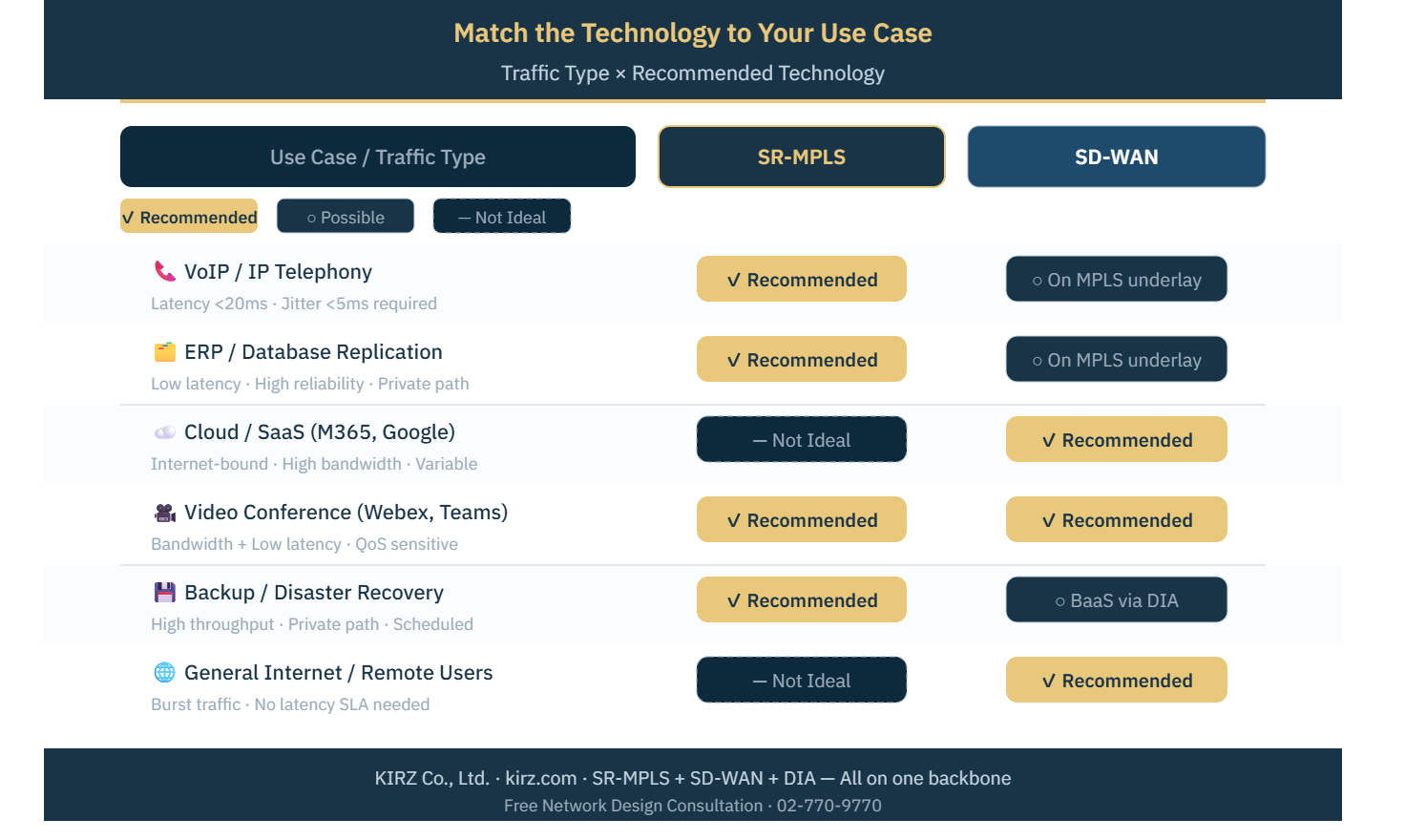
Choose SR-MPLS when:
- Low, stable latency is non-negotiable — VoIP, trading platforms, video conferencing
- Data must travel over a fully private path with zero public internet exposure (finance, healthcare)
- Connecting Data Centers or high-traffic sites that demand maximum reliability
- You need the highest possible SLA — 99.99% uptime with provider-backed guarantees
Choose SD-WAN when:
- Managing multiple sites and requiring centralized control from a single platform
- Looking to reduce WAN costs by blending DIA or 4G/5G connectivity alongside MPLS
- Running multiple cloud applications simultaneously and needing direct cloud access optimization
- Requiring full traffic visibility — application-level, site-level, in real time
- The IT team wants to control routing policy independently without waiting on the provider
Can You Use Both? — Yes, and It Is Recommended
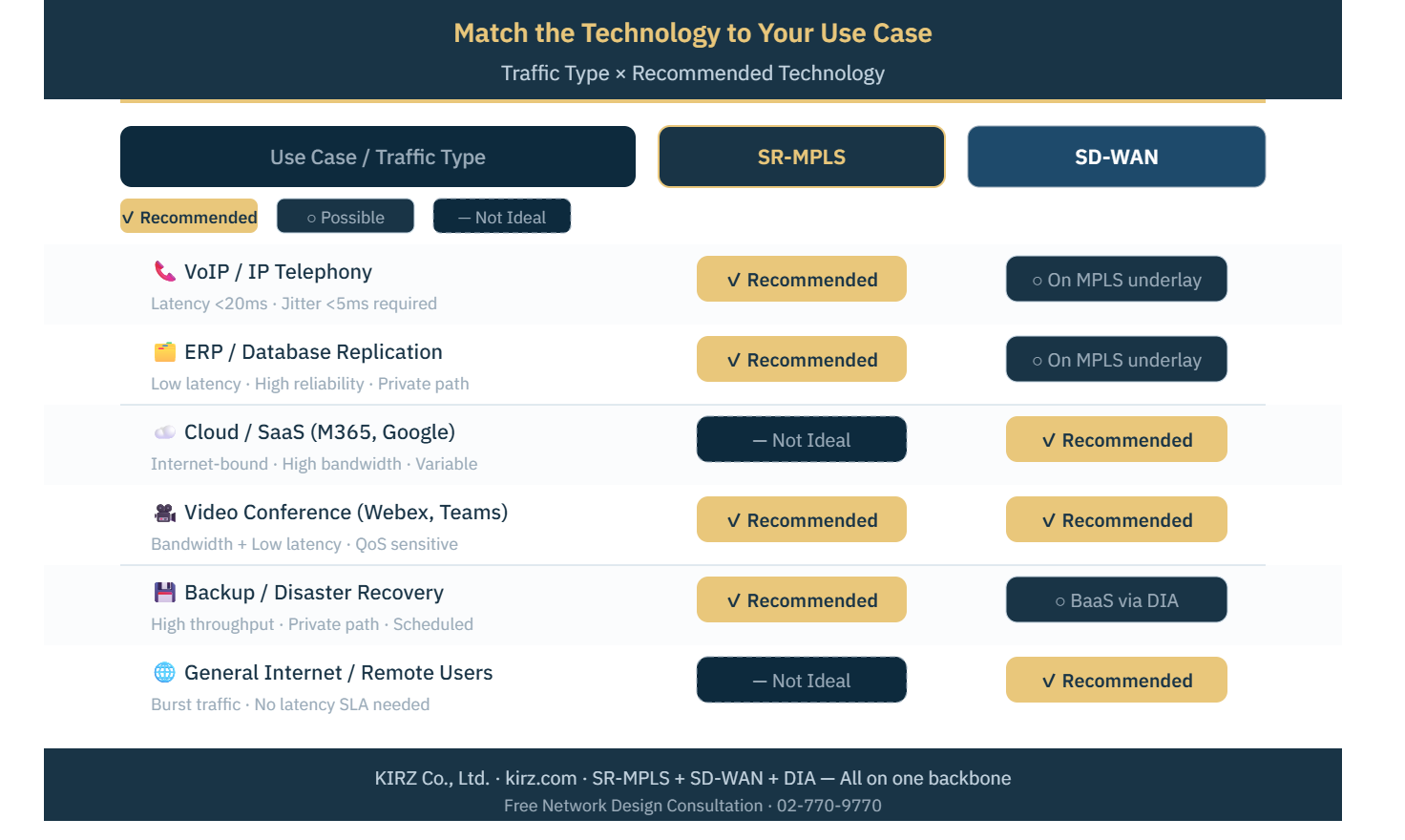
The recommended architecture for mid-to-large enterprises is SD-WAN over SR-MPLS + DIA:
- SR-MPLS serves as the primary underlay for internal traffic requiring low latency and privacy
- DIA serves as the secondary underlay for cloud and internet-bound traffic
- SD-WAN operates as the overlay, automatically managing both paths and routing each traffic type to the appropriate underlay
The result:
- Lower cost — cloud traffic no longer consumes expensive MPLS bandwidth
- Higher resilience — two independent underlay paths provide full redundancy
- Operational flexibility — all routing policy managed centrally from one dashboard
KIRZ Supports Both — On One Infrastructure
KIRZ delivers both technologies on the same underlying fiber network:
SR-MPLS (Private Line):
- 35 switching nodes across Bangkok
- Connected to 30+ Data Centers
- SLA 99.99% · Latency < 5ms within Bangkok
SD-WAN:
- Platforms: Fortinet SD-WAN / Cisco Viptela
- Topologies: Hub-and-Spoke / Full Mesh
- Underlay support: SR-MPLS + DIA + 4G/5G
- Built-in NGFW and IPS
- SLA 99.95%
KIRZ's Presale team is available to design a WAN architecture matched to your site count, traffic profile, and budget — whether that means SR-MPLS, SD-WAN, or a hybrid of both.
Conclusion — Choose the Right Layer
SR-MPLS and SD-WAN are not competing technologies. They are complementary tools operating at different network layers, each solving a distinct problem.
- Need low latency and maximum security? SR-MPLS is the foundation.
- Need flexibility and centralized control? SD-WAN is the enabler.
- Need both? SD-WAN over SR-MPLS + DIA is the answer — and the architecture most enterprise networks are moving toward.
Ready to design the right WAN architecture for your organization?
Contact KIRZ's specialists at kirz.com or call 02-770-9770.